What is CODE RED?
What is CODE RED?
CODE RED is a multifaceted, multiyear campaign, involving over 100 AFT Healthcare throughout the country who will focus on the issue of inadequate staffing to hold healthcare corporations and the government accountable. Ohio Nurses Association is sounding the alarm that understaffing in Ohio hospitals equals a patient care crisis and workplace violence must be addressed. The ONA CODE RED campaign focuses on five strategic areas, including staffing levels, working conditions, pipeline, corporate trends, and trust and agency. Staffing levels have a significant impact on patient outcomes, and nurses play a critical role in advocating for safe staffing ratios. Our campaign will be laser-focused on promoting safe staffing ratios and leveraging employers and lawmakers to implement the staffing ratios our nurses need, and our patients deserve.
CODE RED Q&A
How do you expect employers to hire more RNs when there is a shortage of nurses in Ohio?
In the state of Ohio, we currently have nearly 200,000 registered nurses. In Ohio, one of the main issues is that nurses are leaving the bedside due to deplorable working conditions and moral injury caused by short staffing because of workload. According to forecasts by Becker’s Hospital Review, “Ohio is the #4 state that will need nurses the least by 2030.”
Throwing more money and ratios doesn’t create nurses. What does it solve?
Actually, raising compensation does absolutely help in retaining strong nurses, especially in rural areas where nurses are harder to find. Creating ratios also helps because working at the bedside becomes more manageable allowing nurses to do what they do best….help patients heal.
Can you give an example of how short staffing impacts patient care?
The Journal of Nursing Care Quality conducted a study and found that lower nurse staffing levels were associated with a higher rate of patient falls. According to the Joint Commission (the global driver of quality improvement of patient safety in healthcare) Sentinel Event Data 2022 Annual Review, patient falls were the most prevalent sentinel event type reviewed in 2022. From 2021-2022, there was a 27% increase in sentinel events classified as patient falls.
Do you have any specifics on the legislation you hope to see introduced?
Not at this time. We introduced the Nurse Workforce & Safe Patient Care Act on September 27. We do want to draw attention to the federal Senate Bill 1113 introduced by Sherrod Brown and companion bill introduced by Congresswoman Jan Schakowsky on March 30th that provides staffing ratios, prohibition of imposition of mandatory overtime, the maintaining and enforcement of hospital staffing committees and so much more. In June 2023, ONA surveyed all RNs in the state of Ohio to gain information from which we created a whitepaper to better understand staffing ratios, their impact on patient care and to understand better ways to attract and retain nurses at the bedside.
What happens when your nurse has the maximum number of patients and there is an emergency?
The truth is lack of planning does not constitute an emergency. If hospitals hire the appropriate number of staff, working conditions are manageable and you are then more prepared to handle emergency situations. Unfortunately, the true emergency is the lack of appropriate staffing. In the case of Sherrod Brown’s bill, there is a provision for emergencies.
What is ONA’s position on travel nursing? It seems to me that travel nurses can solve the problem. Travel nursing is only one of the stop gap measures employers have been using for years to avoid hiring the right number of nurses. The compounded effect of practices like abusing on-call and using mandatory overtime are part of the reason experienced nurses are so burned out that they continue leaving the bedside. This isn’t a travel agency problem- it’s a system problem created by employers attempts at cutting labor costs.
Won’t the nurse compact solve this issue?
Since staffing is an issue across the United States, it really doesn’t solve the issue. That is why our hospitals need to make the working conditions better in order to attract nurses to Ohio hospitals since the compact makes it possible for nurses to go to different states. When addressing this complex issue, we need to look through a broader lens. If we want to increase the number of registered nurses in our state, we need to make sure that we address student debt. It is costly to become a registered nurse and nurses are expected to continue their education long after becoming RNs. These educational costs are also leading to faculty shortages. With faculty shortages, the number of nurses graduating is less. The healthcare system is in crisis and staffing needs addressed in many different areas. That is why we are sounding the alarm. We need solutions.
What are our nurses saying about CODE RED?
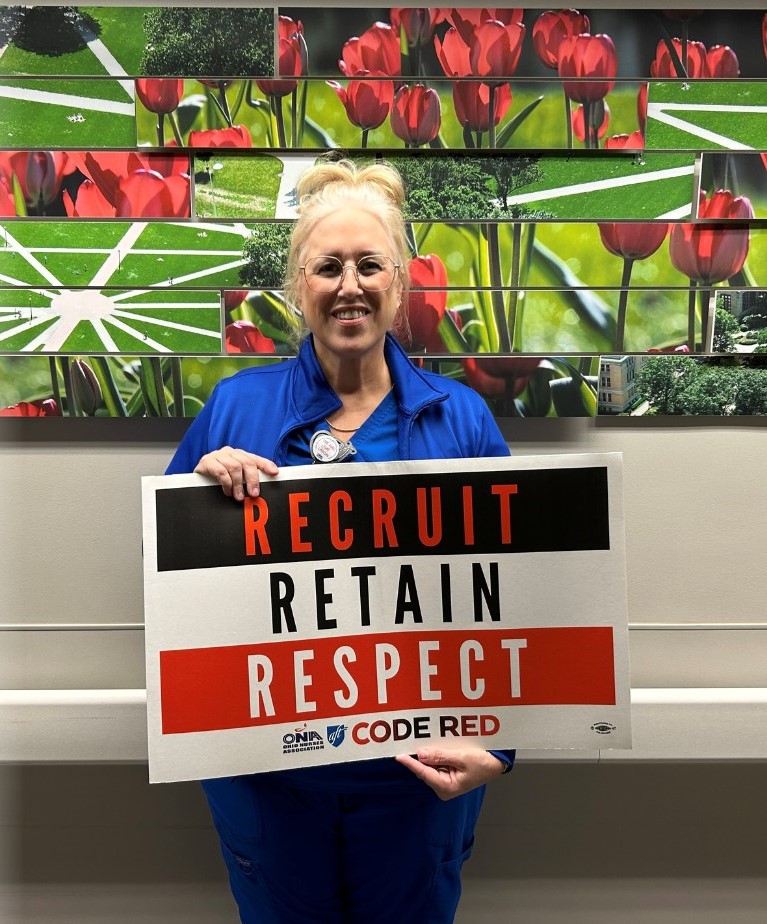

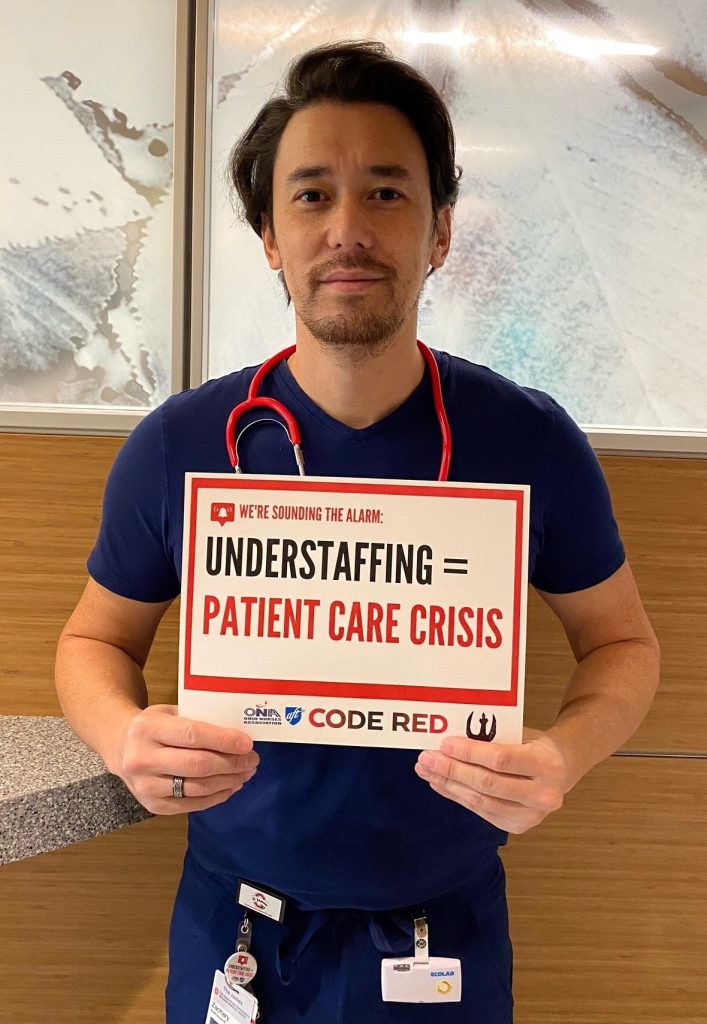

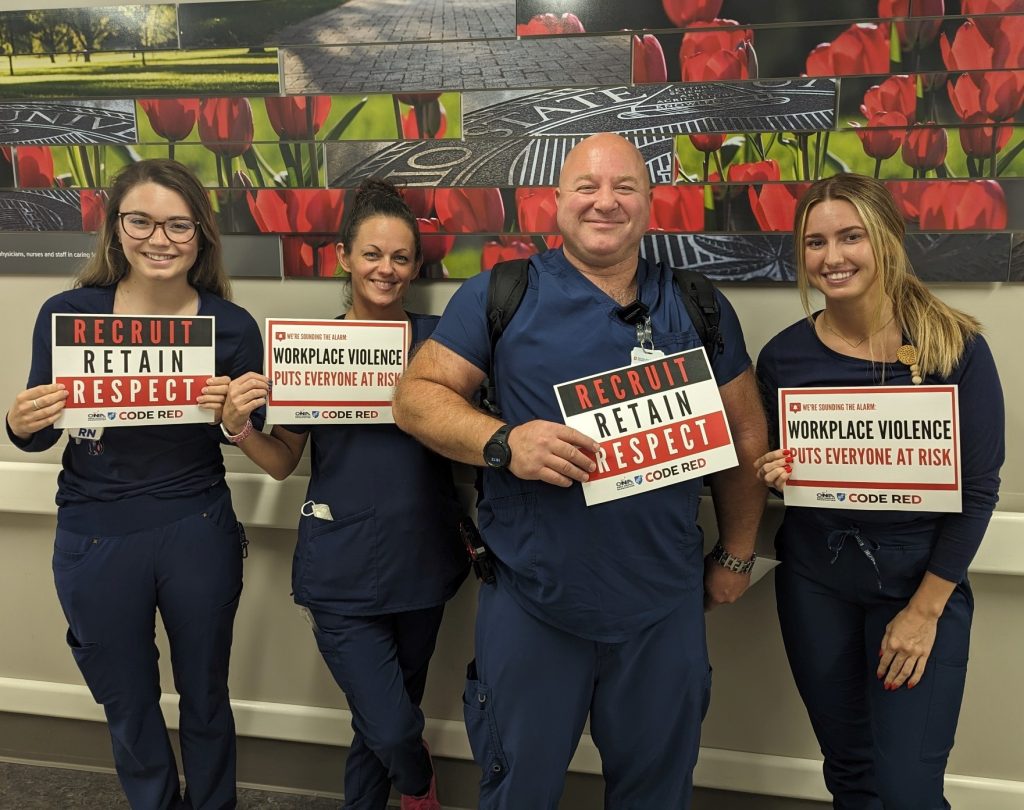
Ohio Nurses Association is sounding the alarm that understaffing in Ohio hospitals equals a patient care crisis that must be addressed.
2025 ONA Official White Paper
ONA Survey of all Ohio Nurses: 2024 Staffing Findings
- 63% of direct care nurses are considering leaving bedside nursing due to current conditions.
- 91% of nurses would strongly support or support a bill that included minimum staffing standards for hospitals.
- 63% of nurses who have left the bedside did so because of patient care load.
- 65% of direct care nurses experienced workplace violence in the last 12 months.
To read the full report, click here.
For nurses and health professionals who are not represented by the Ohio Nurses Association in a collective bargaining unit, ONA has developed the Unsafe Assignment Form (UAF). This form allows you to record an unsafe assignment and/or unsafe conditions. ONA will use this information in aggregate to support advocacy efforts statewide. Submissions will never be shared with personal identifiers.
*UAF is for nurses not represented by ONA in their workplace.